

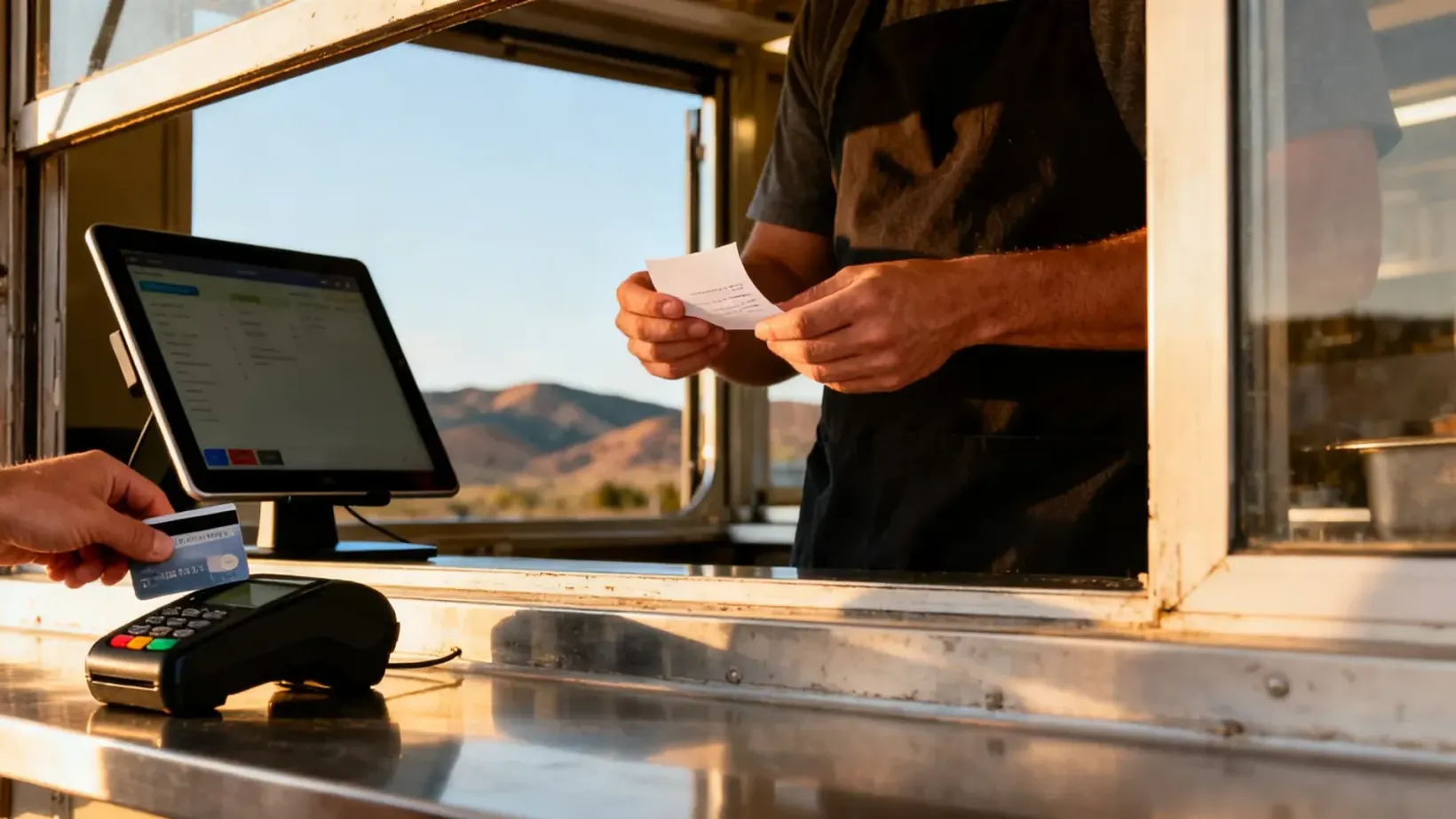
Yes, you can add a credit card surcharge in Colorado. Since July 1, 2022, C.R.S. 5-2-212 has let a merchant add one surcharge per transaction, capped at either 2% of the total or the actual fee you pay your processor on that transaction. You pick one of the two. You have to post the exact sign wording the statute spells out, show the surcharge as its own line on the receipt, and you can't put it on cash, check, debit card or gift card payments.
Debit is the rule that catches people. The 2% is the rule that disappoints them.
Here's what I mean. On a $9 order, 2% is 18 cents. If you pay a flat 2.9% + 30¢ to take that card, your cost on that order is about 56 cents. A surcharge doesn't make card fees go away in Colorado. On small tickets, it barely dents them. I'd rather you know that before you print a sign than after.
What does Colorado's credit card surcharge law say?
Colorado used to ban card surcharges outright. Senate Bill 21-091 repealed the ban, and it took effect July 1, 2022. Here's what the statute requires now, straight from the enacted text:
Rule | What it says | Where it is |
|---|---|---|
The cap | Either up to 2% of the total cost of the transaction, or up to the merchant discount fee you actually pay your processor on that transaction. Pick one method. | C.R.S. 5-2-212(1)(c) |
The sign | Post specific wording where customers can see it, or show it online before checkout. The wording differs by method. | 5-2-212(1)(c)(I) and (II)(B) |
The receipt | The surcharge goes on the receipt as a separate line item. | 5-2-212(1)(d) |
One per sale | Only one card surcharge per transaction. | 5-2-212(1)(e) |
No surcharge on | Cash, check, debit cards (PIN or not), anything processed as debit, and gift card redemptions. | 5-2-212(1)(f) |
Who enforces it | A merchant who breaks these rules is liable as a creditor under Colorado's Uniform Consumer Credit Code, and the buyer counts as a consumer. | 5-2-212(3) |
One more thing in the statute that's easy to miss: subsection (4) says you can surcharge under this law regardless of any contract you sign after it took effect. How far that reaches against your processor's terms is a question for a lawyer, not me. In practice, the card networks still have their own rules, Visa caps credit surcharges at 3%, and processors enforce those rules through your merchant agreement. Plan around the strictest one.
Should you use the 2% cap or the actual-cost cap?
This is the decision that matters, and for anyone with small tickets it isn't close on paper.
The 2% method is simple. Two percent of the total, every time. The cost method lets you charge up to what you actually pay to process that sale. Card fees usually have a fixed piece per transaction, so on a small order your real cost as a percentage is much higher than 2%.
Here's the math at an example flat rate of 2.9% + 30¢. That isn't anyone's quote. Plug in your own rate.
Ticket | Your processing cost | Cost as a % of the ticket | Most you can add at 2% | Most you can add at cost |
|---|---|---|---|---|
$9 | $0.56 | 6.2% | $0.18 | $0.56 |
$15 | $0.74 | 4.9% | $0.30 | $0.74 |
$40 | $1.46 | 3.7% | $0.80 | $1.46 |
$120 | $3.78 | 3.2% | $2.40 | $3.78 |
Now put Visa's 3% ceiling back on top. On that $9 order, 3% is 27 cents, so on a Visa card the cost method gets cut from 56 cents to 27. Still better than 18, but nowhere near covering the fee. That's the shape of it for a food truck or a coffee counter: you recover a slice of your card cost, not the whole thing, under either method.
The cost method has a catch too. The statute says the surcharge can't exceed "the actual amount paid to the processor or service provider to process the transaction." If you're on flat-rate pricing, you know that number at the register. If you're on interchange-plus pricing, where the fee depends on the card type and you find out on your monthly statement, you don't. You can't calculate a per-transaction cap by hand at the window mid-rush. Either your processor computes it for you, or you're guessing, and guessing over the cap is the violation.
What does the Colorado surcharge sign have to say?
Colorado doesn't just require a sign. It writes the sign for you. If you use the 2% method, the statute requires this wording:
"To cover the cost of processing a credit or charge card transaction, and pursuant to section 5-2-212, Colorado Revised Statutes, a seller or lessor may impose a processing surcharge in an amount not to exceed 2% of the total payment made for goods or services purchased or leased by use of a credit or charge card. A seller or lessor shall not impose a processing surcharge on payments made by use of cash, a check, or a debit card or redemption of a gift card."
If you use the cost method, the wording is the same except the cap reads "in an amount not to exceed the merchant discount fee that the seller or lessor incurs in processing the sales or lease transaction."
It's clunky. It reads like a statute because it is one. Don't rewrite it into something friendlier. For in-person sales the sign has to be visible to customers at your premises. For online orders it has to show before the customer completes the order. If you take both, you need both.
Why can't you surcharge debit cards in Colorado?
Because the statute says so, in four separate ways. No surcharge when the customer pays with cash or a check, uses a debit card "whether or not a personal identification number is used," processes the payment as debit, or redeems a gift card.
The trap is that most card readers don't care. A tap is a tap. Plenty of POS setups add a percentage to every card payment, credit or debit, because that's the only switch they have. If yours works that way, the surcharge is landing on debit cards right now, and the statute doesn't give you credit for not knowing.
Test it. Buy something from yourself with a debit card and read the receipt. If there's a surcharge line on it, turn the surcharge off until your system can tell the difference.
How does Colorado's 2026 pricing law change restaurant fees?
A second law took effect January 1, 2026, and it's about service charges, not card surcharges. House Bill 25-1090 added C.R.S. 6-1-737. Its core rule: when you show a price, you have to show the total price, as a single number, more prominently than any other pricing information. "Total price" includes every mandatory fee, but not taxes.
Restaurants and bars get their own path to compliance. A food and beverage establishment complies if, in every offer, display or advertisement, it shows with the price "the percentage or amount of any mandatory service charge and an accurate description of how the mandatory service charge is distributed." So if you add a mandatory 3% kitchen fee or an 18% service charge, the menu, the menu board and the online ordering page all need to say so next to the prices, and say where the money goes. A line in tiny print on the receipt isn't it.
Breaking it is a deceptive trade practice under the Colorado Consumer Protection Act, and the law says a customer doesn't have to send a demand letter before suing over it. The attorney general can write rules to implement it. I haven't found final rules as of today, so check before you rely on anyone's summary, including this one.
The act doesn't mention card surcharges by name. A credit card surcharge is avoidable, because the customer can pay cash or debit, and the "total price" definition turns on what isn't reasonably avoidable. My read is that a properly run credit surcharge stays under 5-2-212's own rules. That's my read, not a ruling.
Did Colorado ban swipe fees on sales tax?
No. Senate Bill 26-134 would have stopped card networks from charging percentage-based interchange on the sales tax portion of a transaction. It passed both chambers in May 2026, and Governor Polis vetoed it on June 3, 2026. The legislature's page lists it as "Did Not Become Law." If you saw the headlines when it passed, nothing changed on your statement.
A checklist before you add a surcharge in Colorado
Read your merchant agreement for a surcharging clause. Your processor can prohibit it even though the state allows it.
Notify your processor and keep the confirmation. The card networks expect notice before you start.
Pick a method: 2% or actual cost. If you pick cost, confirm your processor can compute the per-transaction cap. Don't do it by hand.
Print the exact statutory wording for your method. Post it where customers see it before they pay, and add it to online checkout.
Set the POS to surcharge credit only. Then test with a real debit card and a gift card.
Check that the receipt shows the surcharge as its own line.
If you also charge a mandatory service fee, put its percentage and where the money goes next to every price, on every menu and ordering page.
Re-check once a year. Colorado changed these rules in 2021 and 2025, and nearly again in 2026.
Is a surcharge worth it in Colorado?
Sometimes. For a high-ticket, card-heavy operation, 2% back on every credit sale adds up. For a truck or a counter selling $10 orders, the table above is the honest answer: you get back a fraction of your fee and pay for it in signage, configuration and questions at the window.
You have two other legal routes. You can build card costs into your menu prices, which needs no sign and no special receipt line. Or you can offer a discount for paying cash. Colorado's statute says a cash discount isn't a finance charge as long as it's offered to all buyers and clearly disclosed. The two models work differently and read differently to guests. I wrote up the difference between dual pricing and a cash discount, and how surcharge rules stack across states and card networks.
Where Avocado fits, honestly
Our rate is 5% + 15¢ per card payment, with no monthly software fee. That's more than 2%, so in Colorado a credit surcharge won't cover it, and I'm not going to pretend otherwise.
Who pays our rate is the restaurant's choice: the restaurant, the guest, or a split. But our guest-paid fee is set by payment method, card or cash. It doesn't separate credit from debit. In Colorado, that means our guest-paid card fee isn't built to work as a statute-compliant credit surcharge, because it would land on debit cards too. If you're in Colorado, my honest advice is to cover the rate yourself or build it into your menu prices, and to talk to us before turning on a guest-paid fee.
Avocado is a POS built for independent restaurants and food trucks. We're operators first, and we'd rather tell you the honest version than the version that closes faster.
This is operator experience, not legal advice. Rules vary by state and change often. Statute text is from Colorado SB21-091 (C.R.S. 5-2-212) and HB25-1090 (C.R.S. 6-1-737) as enacted, checked October 31, 2026. Confirm current requirements with the Colorado Attorney General's office or your attorney before you add a surcharge or a service charge.