
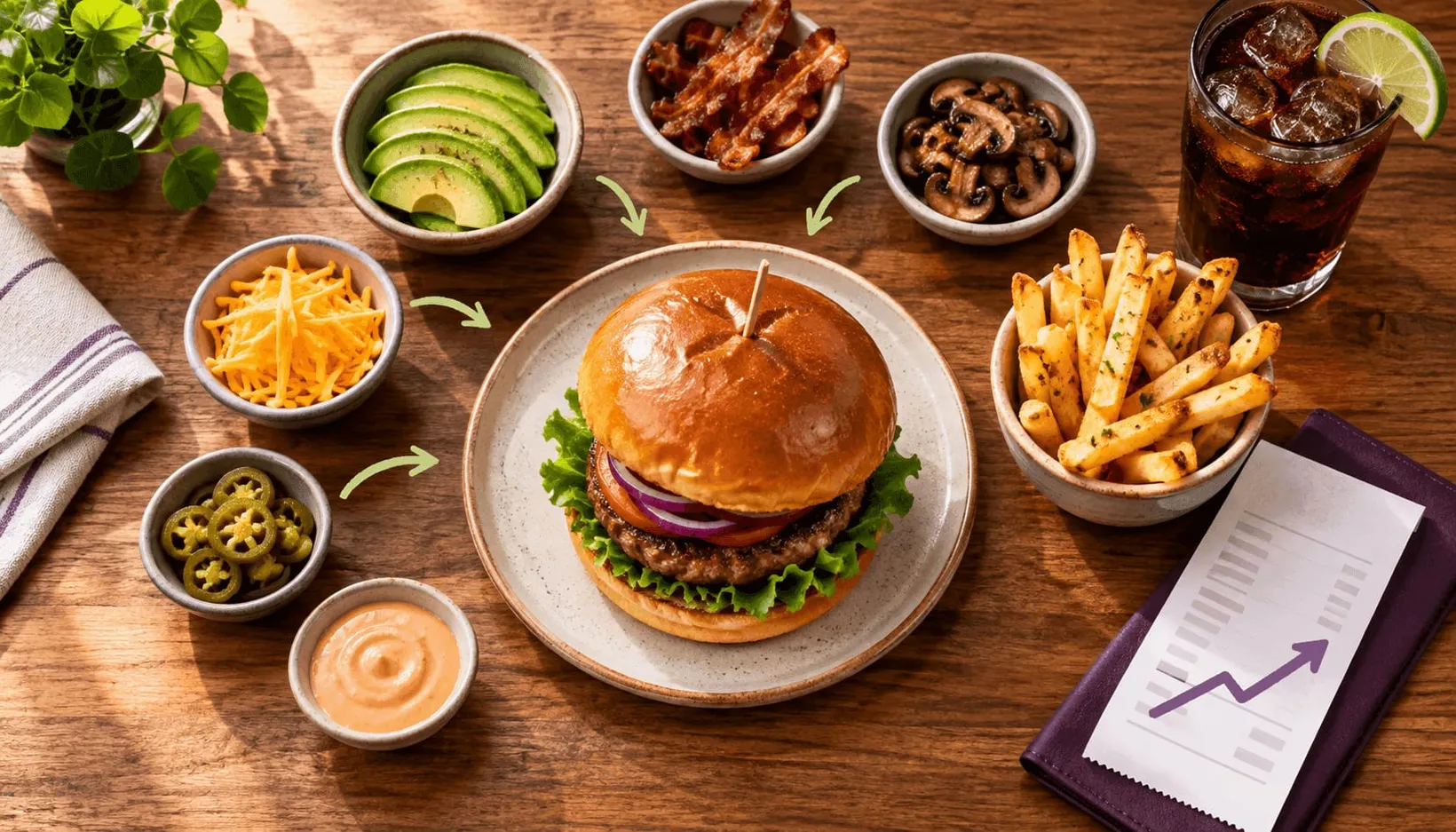
Restaurant upselling does not need to feel pushy. Often, the best upsell is simply a useful choice at the right moment: add avocado, make it a combo, choose an extra sauce, or upgrade the side.
To see what those choices are worth in real restaurant transactions, we analyzed 111,643 eligible orders processed through Avocado. Paid add-ons appeared on about one in six eligible orders, and orders with an add-on had a meaningfully higher average order value.
The numbers at a glance
111,643 eligible orders across 15 restaurant locations
18,700 orders included a paid add-on
16.7% add-on attachment rate
$27.93 average order value with an add-on
$21.86 average order value without one
$6.08 higher average check for orders with an add-on—a raw difference of 27.8%
That $6.08 difference does not mean the add-on caused the entire increase. A larger party or hungrier customer may naturally order both more food and more add-ons. So we also ran a more conservative comparison at the item level.
When we compared the same menu item with and without a paid add-on, the median increase in realized item value was $1.07 per unit, or 17.0%.
What counted as a paid add-on?
We counted an optional menu modifier with a price above zero. Examples include extra cheese, avocado, bacon, a premium side, an additional sauce, or another optional upgrade.
We did not count required choices such as selecting a size or cooking temperature. We also excluded loyalty comps, canceled items, gift card purchases, unpaid orders, and zero-dollar orders. Refunds were subtracted from net sales.
Finding 1: Most eligible orders still do not include an add-on
Only 16.7% of eligible orders included a paid add-on. That means more than four out of five did not. For an owner, this is the opportunity. You do not need every customer to say yes. A small improvement in attachment rate can add revenue across hundreds or thousands of monthly orders.
Use this formula:
Add-on attachment rate = orders with at least one paid add-on ÷ orders eligible for a paid add-on
This gives you a fair week-to-week comparison. It prevents a busy weekend from looking like better upselling when the restaurant simply had more orders.
Finding 2: Orders with add-ons had a $6.08 higher average check
Eligible orders with a paid add-on averaged $27.93, compared with $21.86 for orders without one. That is a raw difference of $6.08, or 27.8%.
Paid add-ons are a strong signal of a larger check. But this does not mean a $1 add-on magically creates another $5 of spending. Customers who customize may also be more likely to add a drink, order a side, or buy for more than one person.
Finding 3: The same item was worth 17% more with an add-on
To get closer to the value of the add-on itself, we matched the same menu item when sold with a paid add-on and without one. We required at least 30 item lines in each group so one unusual order would not dominate the result. This left 84 menu items, covering 19,759 item lines with add-ons and 117,469 without.
The median increase was $1.07 per unit, or 17.0%. The average increase was $1.68, or 18.4%, but the median is the safer benchmark because a few expensive upgrades can pull the average upward.
The headline worth remembering: the middle-performing menu item was worth about 17% more when it carried a paid add-on.
Seven practical upselling techniques to try
1. Offer add-ons only where they make sense
A burger customer understands cheese, bacon, avocado, a premium side, or a drink. A long list of unrelated choices creates friction. Start with the natural next step for each popular item.
2. Use specific, appetizing names
“Add avocado” is clear. “Upgrade” is vague. Name the item, show the price, and keep the language simple enough to understand in a second or two.
3. Keep the choice set short
Three to five relevant paid options are easier to scan than a wall of modifiers. Put popular choices first and remove options almost nobody selects.
4. Start with high-volume menu items
A small lift on a bestseller matters more than a large lift on an item sold twice a week. Review your highest-volume items and give each one or two sensible upgrades.
5. Ask at the decision point
Online, show the add-on while the customer customizes the item. At the counter, use one short question such as, “Would you like avocado on that?” Timing matters more than a complicated script.
6. Track counter and online ordering separately
A digital prompt and an employee suggestion are different experiences. Compare attachment rates by channel. If online performs better, your counter script may need work. If counter performs better, your online menu may be hiding the choice.
7. Test one change at a time
Change the name, price, placement, or staff prompt—but not all four at once. Run the test for a full business cycle, compare it with a similar period, and keep the winner.
A simple weekly add-on scorecard
Review eligible orders, orders with an add-on, attachment rate, add-on net sales, item value with and without add-ons, refunds, voids, food cost, and contribution margin.
Your POS can provide the sales side. Add food cost from your recipe or inventory system before deciding what to promote. A high-selling add-on is not automatically a high-profit add-on.
If you are choosing which items to improve first, combine this scorecard with a basic menu engineering analysis.
What this data does not prove
This analysis shows an association between paid add-ons and higher order value. It is not a controlled experiment, so it cannot prove that a particular prompt or employee caused a customer to spend more.
Avocado records the selected modifier, not whether it came from a verbal suggestion, a POS prompt, or the customer's own choice. We used current modifier settings to identify optional paid add-ons; historical modifier pricing is not stored as a separate snapshot. Finalized item prices and refunds are reflected in the transaction data.
Treat these results as a benchmark, not a promise. Your menu mix, prices, service model, and customers will affect your results.
How we analyzed the orders
We reviewed anonymized, aggregated Avocado transaction data from September 1, 2025 through August 31, 2026. We began with the 20 restaurant locations with the highest net sales. Fifteen had qualifying optional paid modifiers, covering 621 eligible menu items.
The order-level analysis included 111,643 paid, positive-net-sales orders containing at least one eligible item. The matched item analysis included 84 menu items with at least 30 lines both with and without a paid add-on. No restaurant or customer is identified.
The bottom line
Paid add-ons are not a replacement for good food, fair pricing, or strong service. They help customers build the meal they want while increasing the value of the order.
Start small: choose five high-volume items, give each a short list of relevant upgrades, and track attachment rate every week. You do not need an aggressive sales pitch. You need a clear offer, shown at the right time, and a simple way to measure whether it works.