
In Florida, a food truck that cooks needs one state license: a Mobile Food Dispensing Vehicle (MFDV) license from the Division of Hotels and Restaurants at the Department of Business and Professional Regulation (DBPR). It costs $347 a year plus a $50 application fee for a new license, plan review is free, and under Florida Statute 509.102 your city or county can't make you buy a second food truck license on top of it. They can still tell you where you're allowed to park.
That's the short answer. The long answer is where people lose a month.
When I ran Bun Boiz, a street food stall in college, the food was never the hard part. The hard part was the stack of paper, and figuring out which office actually owned which piece of it. Most of the bad advice I hear from new operators comes from the same place: they asked the wrong agency, or they asked the right agency the wrong question. Florida is one of the easier states to get this right, but only if you know where the lines are drawn.
Which Florida agency issues your food truck permit?
Florida splits mobile food between three agencies, and the split is about what you sell, not what you drive.
What you sell | Who licenses you | What it's called |
|---|---|---|
Food you cook or prepare on board: burgers, tacos, hot dogs, anything that needs temperature control | DBPR, Division of Hotels and Restaurants | Mobile Food Dispensing Vehicle (MFDV) license |
Only prepackaged food, or foods that aren't potentially hazardous: ice confections, coffee, tea, soft drinks, pastry, popcorn, candy | Florida Department of Agriculture and Consumer Services (FDACS) | Mobile food establishment permit |
Anything, if you operate on institutional property the Department of Health licenses, like a school or nursing home | Department of Health (DOH) | Contact DOH directly |
If you're running a real food truck, you're almost certainly in the first row. FDACS says it plainly on its mobile vendor page: units that prepare potentially hazardous foods like hot dogs and hamburgers fall under DBPR.
The trap is the coffee trailer that later adds breakfast sandwiches. The moment you start cooking, you've moved agencies. Decide your menu before you apply, not after.
How much does a Florida food truck license cost?
These are the DBPR numbers for a Mobile Food Dispensing Vehicle, from the Division of Hotels and Restaurants fee page and Florida Administrative Code rule 61C-1.008:
Fee | Amount | When you pay it |
|---|---|---|
Application fee | $50 | New license or change of ownership only |
Annual license fee | $347 | Every year at renewal |
Half-year license fee | $178.50 | If you apply 6 months or less before the next renewal period |
Plan review | $0 | DBPR doesn't charge for it |
Late renewal | $50 delinquency fee | On top of the renewal fee, if you renew after expiration |
The $347 breaks down as a $185 basic fee, a $135 service fee, a $17 epidemiological fee and a $10 hospitality education fee. Hot dog carts pay the same.
So a brand-new truck is $397 to the state in year one, or $228.50 if your timing lands you in the half-year window. That's it for the state food license. If somebody quotes you a lot more than that for "the permit," ask what else they've bundled in.
What does Florida Statute 509.102 actually stop your city from doing?
This is the part that makes Florida different, and it's the part most operators have never read.
Since July 1, 2020, Florida has preempted mobile food dispensing vehicle licensing to the state. Under 509.102, a city or county can't:
Require you to get a separate local license, registration or permit to operate the truck, beyond your state MFDV license.
Charge you fees for that beyond what the state charges.
Ban food trucks from operating anywhere in its jurisdiction.
What a city or county can still do is regulate everything else. The statute says local governments keep their authority over mobile food vehicles except for the licensing and fee pieces. In practice that means zoning, which streets and lots you can park on, hours, distance rules, and private property permission are all still local.
Here's how I'd read that as an operator: Florida took away the city's ability to charge you twice for the right to exist. It didn't give you the right to park anywhere you want. Plenty of towns put this on their own websites now. Longwood's food truck page, for example, says outright that the state prohibits cities from requiring a permit or charging a permit fee to locate a food truck on a site.
The exception: 509.102 doesn't apply to port authorities, airports, aviation authorities or seaports. If you want to sell at a port, expect their rules and their fees.
What are the steps to get an MFDV license?
Make a DBPR online account. Everything up to the inspection happens online.
Figure out whether you need plan review. You do if the vehicle has never been licensed by the division, has been closed more than 18 months, or has been remodeled. You don't if you bought a truck that's already licensed and you changed nothing.
Put your plan review packet together. DBPR wants a vehicle plan with the equipment labeled, a sample menu, a side photo showing the wheels and the open service window, and your water and sewer or commissary location.
Apply and pay. DBPR offers a combined license and plan review application, and it's the faster route if you need both.
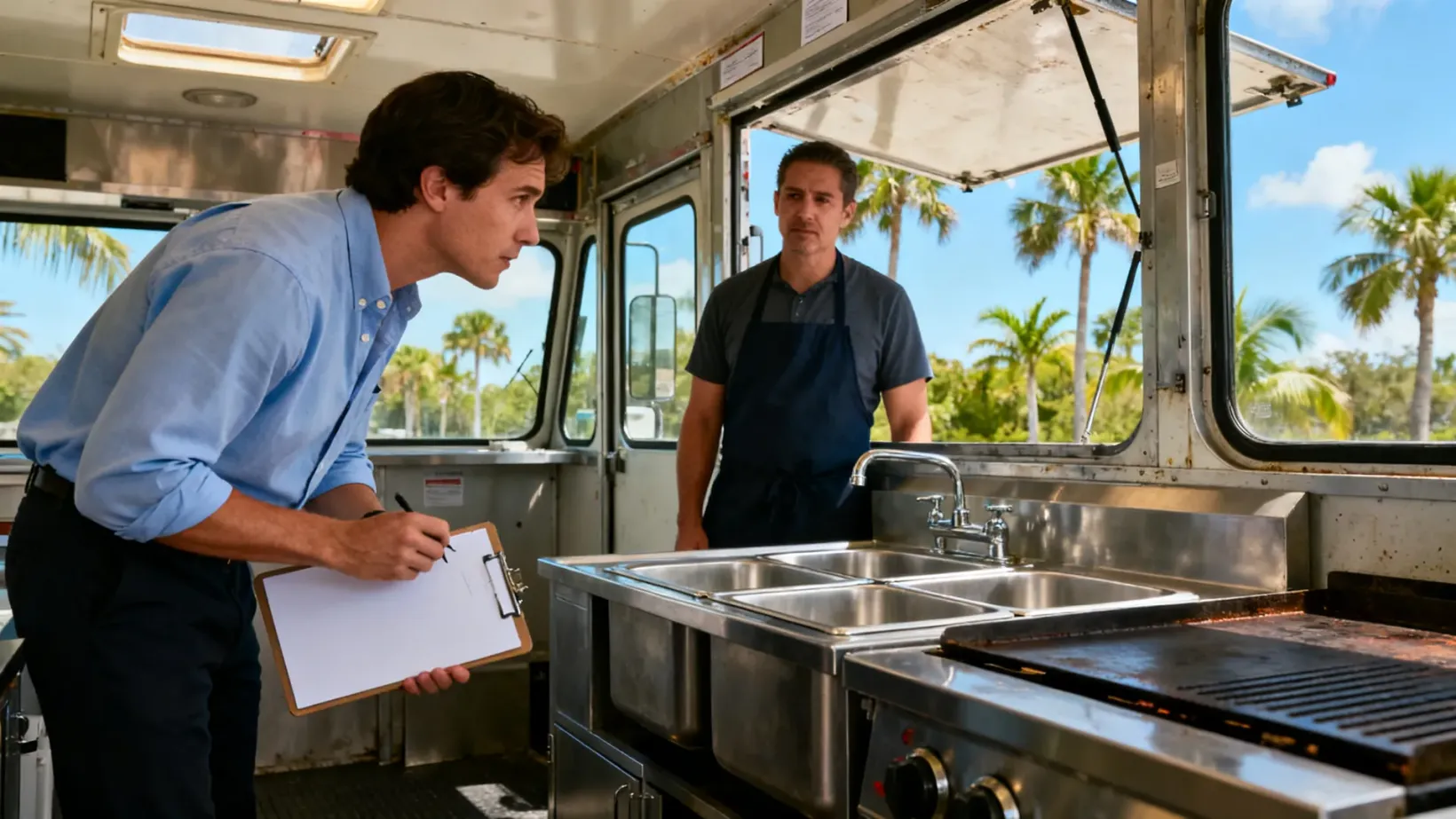
Pass the opening inspection. Every new licensee gets a sanitation and safety inspection before opening.
Once you're licensed, you can drive and sell anywhere in the state, take catering jobs, and work a 1 to 3 day temporary event without paying a separate temporary event fee.
Do you need a commissary for a food truck in Florida?
For water and waste, yes, in the practical sense. DBPR requires an MFDV to fill its water tank and empty its wastewater tank at a commercial location: a commissary, or a facility like a truck stop. Not your house.
The bigger rule is about prep. DBPR says food storage and preparation have to happen in an approved, licensed establishment, not a private residence. So if your truck can't hold and prep everything on board (DBPR calls that "self-sufficient"), you need somewhere licensed to do it. Any FDACS-permitted or DBPR-licensed fixed food establishment can serve as your commissary.
The commissary is usually the biggest recurring cost in this whole stack, much bigger than the $347. I wrote up what a commissary actually costs and what to ask before you sign, because the hourly rate is the least useful number in that deal.
What still isn't covered by the state license?
The MFDV license is your food service license. It isn't your whole business. Before your first service, check:
Where you can park. Zoning and property rules are still local. Call the city's planning or zoning office with the exact address, not the general question.
Private property permission. A brewery or office park letting you set up is a contract with them. Get it in writing.
Sales tax. Prepared food is taxable in Florida. Register with the Florida Department of Revenue before you sell.
Fire safety at events. Many event organizers require a fire inspection of your propane and cooking setup. Ask the organizer what they need before you sign the application.
The vehicle itself. Registration and commercial auto insurance are separate from anything DBPR does.
If a city tells you that you need a local food truck permit, it's fair to ask, politely, how that squares with 509.102. Sometimes the answer is that what they're asking for is a zoning approval for a specific site, which they're still allowed to require. Sometimes the answer is that the form is out of date.
Where this gets harder
The honest caveat: the statute settles licensing and fees. It doesn't settle every fight with every city. A town can't ban you outright, but it can make the legal places to park scarce, and challenging that takes time most owners don't have in the middle of a season. Preemption is leverage in a conversation, not a guarantee you'll win it.
And the license is the cheap part. What actually decides whether a Florida truck makes it is the same as anywhere else: whether the events you say yes to cover the commissary, the fuel, the labor and the slow days. I've watched operators pass every inspection and still lose money because they never did the event math before signing up.
That's where we come in, lightly. Avocado runs on an iPad at the window, keeps working offline when the event Wi-Fi dies, and doesn't charge a monthly software fee, so a slow month doesn't come with a bill for the software that tracked it.
Avocado is a POS built for independent restaurants and food trucks. We're operators first, and we'd rather tell you the honest version than the version that closes faster.
This is operator experience, not legal advice. Fees and rules are from DBPR, FDACS and the Florida Statutes as of October 2026. Rules change, so confirm current requirements with DBPR's Division of Hotels and Restaurants and your local zoning office before you apply.