

A food truck permit usually isn't one fee, so there's no single price. The state license is the cheap, predictable part. In Florida it's $347 a year plus a $50 application fee. In Texas, since July 1, 2026, the state application runs $309 to $876 per truck depending on what you cook, and trucks that handle food also pay a $400 or $500 inspection fee. What actually sets your permit budget is how many cities and counties you sell in, because a lot of the paperwork repeats in every one of them.
That's the part nobody prices out up front. When I ran Bun Boiz, a street food stall in college, the food was never the hard part. The paperwork was, and it wasn't one form. It was a stack, and the stack got taller every time we wanted to sell somewhere new.
So here's how I'd think about it if I were budgeting a truck today.
How much does a food truck permit cost?
Here are the state-level numbers I could verify against the agencies themselves this week. They're floors, not totals.
State | What you buy | What it costs | Source |
|---|---|---|---|
Florida | Mobile Food Dispensing Vehicle (MFDV) license from DBPR, for trucks that cook | $347 a year, or $178.50 if you apply 6 months or less before renewal, plus a $50 application fee for a new license | DBPR Division of Hotels and Restaurants fee page |
Texas, Type I (prepackaged, low-risk only) | Statewide mobile food vendor license from DSHS, one per vehicle | $309 application fee, no pre-licensing inspection fee | DSHS mobile food vendor page |
Texas, Type II (limited handling) | Same license | $618 application fee plus a $400 pre-licensing inspection, so $1,018 to get started | DSHS mobile food vendor page |
Texas, Type III (you cook and hold on board) | Same license | $876 application fee plus a $500 pre-licensing inspection, so $1,376 to get started | DSHS mobile food vendor page |
Colorado | A health license from the state health department or from Denver, now honored statewide | Not a statewide flat fee. Depends on who licenses you. | HB25-1295, in effect January 1, 2026 |
Two things jump out. First, Texas licenses each vehicle separately, so a second truck is a second license. Second, most real trucks are Type III. If you're grilling, frying or holding hot food, plan on the top row of the Texas fees, not the bottom one.
If you're in Florida, I broke down what the Florida license covers and what your city can't charge on top of it in its own post.
What permits does a food truck need?
The names change by state and city, but almost every truck I talk to ends up with some version of these layers. This is the stack:
Layer | Who usually issues it | How often you pay | What makes it expensive |
|---|---|---|---|
Health permit or mobile food license | State or county health department | Yearly | Cooking on board instead of selling prepackaged food |
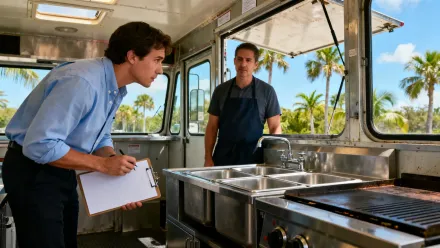
Plan review and opening inspection | Same health agency | Once, then again after a remodel | A truck that was never licensed, or a build that doesn't pass the first time |
Business license | City or county | Yearly, in each place that requires one | Selling in several towns |
Sales tax registration | State revenue department | Usually free to register | Nothing up front, but it's the one people skip and regret |
Fire inspection | Local fire department or marshal | Yearly, or per event | Propane and fryers, and events that want their own inspection |
Vending or parking permit | City transportation or zoning office | Yearly or per location | Selling on public streets in a big city |
Temporary event permit | Event's local health department | Per event | A busy festival calendar |
Commissary agreement | A private kitchen, often required by the health permit | Monthly | Usually the biggest recurring number in the whole stack |
That last row isn't a permit, but the permit is often what forces you into it, and it costs more than everything above it combined for a lot of operators. Before you sign one, read what a commissary actually costs and what to ask.
Why does the number of cities you sell in matter more than the fee?
I call it the permit multiplier. Your real permit cost isn't the license. It's this:
Permit cost = the state or county license + (the local layer × the number of jurisdictions you sell in) + (event fees × the number of events)
A truck that parks in one town five days a week has a multiplier of one. A truck that chases breweries in four suburbs and does a festival a month might be paying the local layer four or five times over, plus a stack of one-off event fees. Same truck, same menu, very different permit bill.
This is also why the most useful permit news of the last few years has been about the multiplier, not the fee:
Florida preempted food truck licensing to the state in 2020. Under Statute 509.102, a city or county can't make you buy a second license for the truck or ban food trucks outright. It can still regulate where you park.
Texas moved mobile food vendors to one state license on July 1, 2026, under HB 2844. A city can't prohibit a licensed truck from operating there, but you still follow local fire codes, location rules and zoning.
Colorado's HB25-1295, in effect January 1, 2026, makes a health license from the state or from Denver good across the state. You send the local government a copy at least 14 days before you operate there. Fire permits travel too, as long as a certified fire inspector did the inspection under a current fire code.
None of these make the multiplier disappear. They take the biggest repeated layer, the health permit, out of it. Fire, parking and zoning still come with you to every new town.
How do I estimate my own food truck permit budget?
Do this before you buy the truck, not after.
Write down every place you plan to sell in year one. Not the dream list. The towns, lots and events you'd actually book.
Find out who licenses you for health. Call your state health department and ask whether mobile food is licensed by the state or by the county. That one answer tells you whether your health permit multiplies.
Pick your menu before you apply. In Texas, prepackaged-only is Type I and cooking on board is Type III, and the difference is more than $1,000 at the start. A coffee trailer that later adds breakfast sandwiches can change categories.
Call each city on your list with the same three questions. Do I need a business license here? Do I need a separate fire inspection? Where am I allowed to park? Ask about a specific address, not "food trucks in general."
Ask every event what it requires. Some want their own fire inspection or a temporary food permit on top of your yearly license. Get it in writing before you pay the booth fee.
Put it in one table. Layer, issuer, cost, renewal date. Then multiply the local rows by the number of places on your list.
Here's the worksheet I'd use:
Line | Cost | × How many | Year-one total |
|---|---|---|---|
State or county health license | 1, or 1 per county if counties license you | ||
Plan review and opening inspection | 1 | ||
City business licenses | Cities on your list | ||
Fire inspections | Jurisdictions or events that require one | ||
Vending or parking permits | Locations that require one | ||
Temporary event permits | Events per year | ||
Commissary | 12 months |
If the total surprises you, good. It's better to be surprised on paper.
What's the honest caveat?
Fees change, and they change quietly. The Texas numbers above are the final ones on the DSHS site, and they're higher than what the state floated in its earlier drafts. Any guide quoting a number from last year, including this one a year from now, might be wrong. Check the agency's own fee page the week you apply.
A statewide license also isn't a right to park anywhere. Florida, Texas and Colorado all left zoning and location rules with the cities. A town that can't ban you can still make the legal spots scarce, and fighting that takes time you don't have mid-season.
And the cheapest permit plan isn't always the best one. Staying in one town keeps your multiplier at one, but if that town can't feed the truck five days a week, you've saved a few hundred dollars in permits and lost a lot more in sales.
Where does doing this by hand break down?
Not at the application. At the renewals. Once you're licensed in a handful of places, you've got different agencies, different renewal months and different inspection schedules, and nobody sends you a reminder that matters. The real question every year is which of those towns actually paid for its permits.
That's a sales question, not a paperwork question. You need to know what each day at each spot actually brought in, then put it next to what it cost to be allowed there. I wrote up the event math I'd run before saying yes to any booking, and the same logic works for deciding whether a city is worth renewing.
That's where we come in, lightly. Avocado runs on an iPad at the window, keeps taking orders offline when the lot's Wi-Fi drops, and gives you your sales by day without a monthly software fee. So when renewal season comes, you're looking at real numbers instead of a feeling about which Saturdays were good.
Avocado is a POS built for independent restaurants and food trucks. We're operators first, and we'd rather tell you the honest version than the version that closes faster.
This is operator experience, not legal advice. Fees and rules are from the Florida DBPR, the Texas Department of State Health Services, Texas HB 2844 and Colorado HB25-1295 as of November 2026. Rules vary by state and city and change often, so confirm current requirements with your health department and local offices before you apply.