
Texas's cottage food law now lets you sell almost any food you make in your home kitchen straight to customers, up to $150,000 in gross sales a year. Your city can't require a permit or charge you a fee for it. The exceptions are meat and poultry, seafood, ice cream and other ice products, low-acid canned goods, anything with CBD or THC, and raw milk. You need a food handler certificate and a proper label. Foods that have to stay refrigerated are allowed too, but only if you register with the Texas Department of State Health Services (DSHS) first.
That's what Senate Bill 541 did, effective September 1, 2025. It rewrote the law Texas first passed in 2011, and plenty of pages ranking for it, including some city brochures, still list the old $50,000 cap.
Here's what I'd want a friend to know before they print a single label. I came up through a street food stall, Bun Boiz, not a home kitchen, so this is the statute read from the operator's side of the table, not a lawyer's.
What changed in the Texas cottage food law in 2025?
The old law was a permission list. It named about twenty kinds of food you could sell, like baked goods, candy, jams, pickles and granola, plus "any other food" that didn't need refrigeration. SB 541 turned it around. Now everything is allowed except a short list of excluded foods.
Rule | Before September 1, 2025 | Since September 1, 2025 (SB 541) |
|---|---|---|
Annual sales cap | $50,000 gross | $150,000 gross, adjusted every year for inflation by DSHS |
What you can sell | A named list of foods that don't need refrigeration | Any food except the six excluded categories |
Refrigerated foods (cheesecake, tres leches, cream pies) | Not allowed | Allowed if you register with DSHS, keep them cold and add a dated safe-handling label |
Who you can sell to | Only directly to consumers | Directly to consumers, or wholesale to a registered cottage food vendor |
Who can operate | An individual working from home | An individual working from home, or a 501(c)(3) nonprofit working from a director's or officer's home |
Address on the label | Required | Can be replaced with a DSHS registration number |
What foods can you sell under the Texas cottage food law?
Start from the exclusions, because that's how the statute is written now. Texas Health and Safety Code §437.001(2-b) says you can produce any food at home other than:
Meat, meat products, poultry or poultry products
Seafood, fish and shellfish, and products made from them
Ice and ice products, including shaved ice, ice cream, frozen custard, popsicles and gelato
Low-acid canned goods
Products containing CBD or THC
Raw milk and raw milk products
The list is short, but it rules out a lot of Texas food. Here's how it plays out for things people actually want to sell from home:
Food | Allowed? | Why |
|---|---|---|
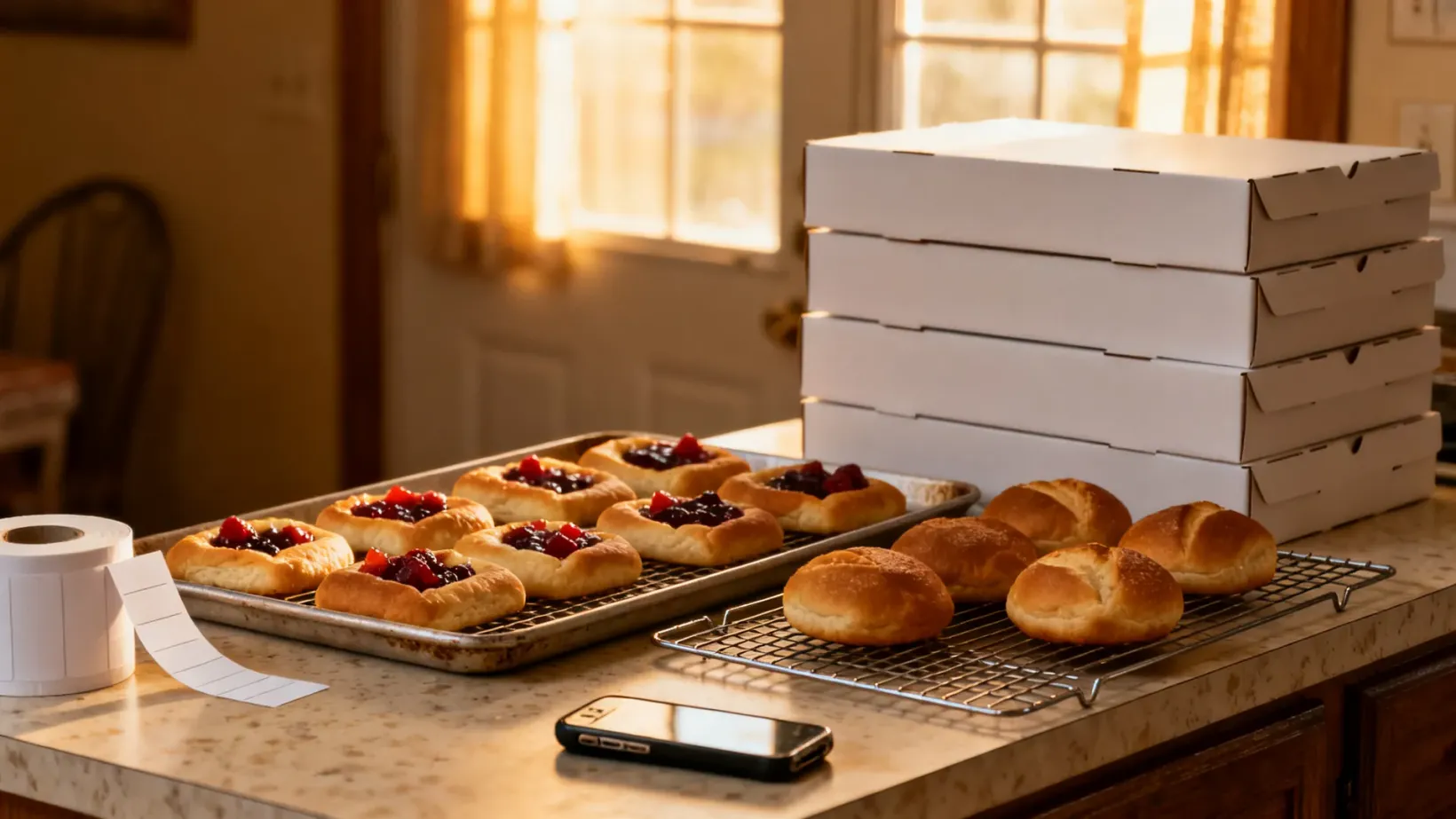
Cookies, bread, pan dulce, fruit pies, fruit kolaches | Yes | Not excluded and shelf-stable |
Sausage kolaches, pork or chicken tamales, brisket, jerky | No | Meat and poultry are excluded, no matter how they're cooked |
Tres leches, cheesecake, cream pies | Yes, with registration | Refrigerated baked goods are time and temperature control for safety (TCS) food |
Paletas, raspas, ice cream | No | Ice products are excluded by name |
Pickles, fermented vegetables, plant-based acidified canned goods | Yes, with conditions | You need an approved or lab-tested recipe, or you pH-test every batch to 4.6 or below, and you keep batch records for 12 months (§437.01951) |
Candy, granola, roasted coffee, dry spice mixes | Yes | Not excluded and shelf-stable |
The tamale row is the one that surprises people. Colorado's new law, which takes effect January 1, 2027, was written specifically so home cooks can sell tamales, meat ones included. Texas didn't go that far. A bean-and-cheese or rajas tamal isn't on the excluded list, but cheese makes it a food that needs temperature control, so you'd need to register first. A pork tamal is out, full stop.
Do you need a permit to sell cottage food in Texas?
Not from your city or county. Under §437.0192, a local government, including the local health department, can't regulate production at a cottage food operation and can't require any license, permit or fee to produce or sell to consumers, or to give out samples. The law even bars a city from keeping someone on staff who knowingly tries to make you get one.
What you do need from the state:
A food handler certificate. Anyone running a cottage food operation has to complete an accredited food handler course (§437.0195). Anyone helping you has to have one too, work under your direct supervision, or live in your household. DSHS says it accepts a food manager certification in its place.
DSHS registration if you sell refrigerated food. If anything you sell is TCS food, you have to register with DSHS before you sell it (§437.01953). DSHS runs this through its online licensing system and doesn't list a registration fee.
Optional registration to keep your address off the label. Register and DSHS gives you an ID number to print instead of your home address. If you sell from home, that's worth doing for this reason alone.
Where can you sell, and can you sell online?
You can sell directly to consumers in Texas. The food has to be handed over at the point of sale or at a place the customer picks, like their house, your porch or a park. You can also give out samples anywhere in the state.
Online is allowed, with a catch. Under §437.0194, an internet sale only counts if you, an employee or someone in your household personally delivers the food. You also have to post your label information on your website before you take payment. In practice, that means taking orders online and delivering them yourself or handing them over at a pickup spot. Shipping boxes across the state doesn't fit that language.
The other new channel is the cottage food vendor: a business you have a contract with that sells your food for you, at farmers markets, farm stands, restaurants or retail stores. Three limits apply. Vendors can only sell food that doesn't need refrigeration, they have to post the "produced in a private residence" sign near your product, and they have to register with DSHS if they buy from you wholesale. Your refrigerated items stay direct-to-customer.
What has to be on a Texas cottage food label?
Use this as a checklist (§437.0193):
Package the food so it can't get contaminated, unless it's too big to package normally.
Print your operation's name.
Print your address, or your DSHS registration number if you've registered.
Print this sentence, word for word: "THIS PRODUCT WAS PRODUCED IN A PRIVATE RESIDENCE THAT IS NOT SUBJECT TO GOVERNMENTAL LICENSING OR INSPECTION."
For refrigerated (TCS) food, add the date it was made.
For refrigerated food, also put this on the label or the receipt, in at least 12-point type: "SAFE HANDLING INSTRUCTIONS: To prevent illness from bacteria, keep this food refrigerated or frozen until the food is prepared for consumption."
For unpackaged items, put the required label information on the invoice or receipt instead.
For pickled, fermented or acidified products, label each batch with a unique batch number.
DSHS rules can add requirements on top of the statute, so check its cottage food page before your first print run. Allergen labeling is a good habit even where it isn't spelled out.
Is the $150,000 cap gross sales or profit?
It's gross. The statute says "annual gross income from the sale of food," which means everything customers pay you, before flour, butter, boxes, market fees or card fees come out.
I think about it as the cottage ceiling, and the number matters less than how close you are to it. $150,000 spread over 52 weeks is about $2,885 a week in sales. If you sell at two markets a weekend and take delivery orders midweek, you won't hit that by accident. If you've built a real following, you might hit it by October.
Three signs you're close to the ceiling and should start planning your next step before you hit it:
You're near the cap. If you're tracking past $100,000 by midyear, plan the move to a commissary or permitted kitchen now. Don't wait until you're over.
Customers keep asking for the excluded items. If half your DMs are about pork tamales or brisket, the cottage law will never let you sell what your market wants. That's a food truck or a commissary kitchen conversation.
A store wants to stock your refrigerated product. Vendors can't carry TCS food, so the tres leches a coffee shop wants on its shelf has to come out of a licensed kitchen.
What doesn't the cottage food law cover?
This is the honest part. SB 541 settles licensing, permits and fees. It doesn't touch these:
Sales tax. The cottage food statute is silent on it. Some food is taxable in Texas and some isn't, so ask the Texas Comptroller about your specific products before you set prices.
Zoning, HOA rules and deed restrictions. The statute bars local health permits and fees for production and sales. It says nothing about your HOA's rules on customer traffic or a sign in your yard.
Insurance and liability. Nobody inspects your kitchen, so if someone gets sick, the risk is yours. Ask an insurance agent about product liability before you scale.
Emergencies. The exemption doesn't stop DSHS or a local health authority from stepping in over an immediate and serious health threat (§437.0191(b)).
Where doing it by hand breaks down
Most cottage operations start with a notebook, a cash box and Venmo. That holds up until two things get hard at the same time: knowing your real year-to-date gross, and getting a label onto every receipt for the items you don't package. At one market a week, the notebook is fine. At three channels (market, porch pickup and delivery), the notebook is guessing, and the cottage ceiling isn't a number you want to guess at.
If you're selling at markets now, start with how to take cards at a farmers market with just your phone. You don't need hardware to begin.
That's where Avocado fits, lightly. You can take cards with Tap to Pay on your iPhone with no monthly software fee, take pre-orders online for pickup, and see every sale in one place instead of three apps. When you outgrow the cottage ceiling, the same account moves with you to a truck or a storefront.
Avocado is a POS built for independent restaurants and food trucks. We're operators first, and we'd rather tell you the honest version than the version that closes faster.
This is operator experience, not legal advice. Rules are from Texas Health and Safety Code Chapter 437 as amended by SB 541 (effective September 1, 2025) and DSHS guidance as of October 2026. DSHS adjusts the $150,000 cap for inflation and can add rules, so confirm current requirements with DSHS, the Texas Comptroller and your local zoning office before you start selling.